Sounds like AI
Apparently, “sounds like AI” is an insult now.
It shows up under blog posts, on Reddit, beneath LinkedIn updates. Sometimes all it takes is three paragraphs without a typo.
It’s rarely about style. What people mean is: you didn’t write this.
And that changes everything. A sharp idea suddenly feels cheap. The author you thought was clever might just have typed a prompt. Often the suspicion alone is enough.
That’s odd, when you think about it. With almost no other tool do we skip so quickly past the work itself and go straight to whether its author deserves credit.
We Already Use It
Meanwhile, most of us are already using it.
I use AI to suggest code, to translate, to research, to sort out my thoughts, and yes, to write. None of it feels exotic anymore. It’s about as thrilling as autocomplete, just far more confident when it’s wrong.
The trouble starts when you can no longer tell where the tool ends and the author begins.
A spell checker can fix a sentence. An editor can rearrange it. A colleague can tell you the whole paragraph doesn’t work. Nobody questions your authorship over any of that.
With AI, a fixed comma can be enough.
Photoshop
It reminds me of Photoshop.
At some point, Photoshop stopped being just software. “That’s been photoshopped” became a verdict.
Once something was edited, it somehow felt less real.
The line was blurry even then. Boosting the contrast was fine. Removing a blemish, usually. Swapping out the sky, that’s where people started to wonder. Somewhere between touch-up and fake, a line got crossed, and nobody could say exactly where.
Generative AI is going through something similar.
With Photoshop, we asked whether the picture was authentic. With AI, we’re asking whether the author is.
That line is even harder to draw.
Who Wrote This Sentence?
Take a single paragraph.
I can write it myself and run a spell check.
I can ask an AI to smooth out one clunky sentence.
I can have it generate three versions and pick the best.
I can have it write a rough draft and rework it until almost nothing of the original survives.
Or I can type:
Write me an article about AI and authorship.
And hit publish.
AI was involved every time. But these don’t feel remotely the same.
We barely have words for the difference. Most of it ends up in one of two boxes:
Human-written.
AI-generated.
There’s a lot of space in between.
Suspicion Is Enough
It gets stranger when no AI was involved at all.
People now get accused because of certain phrases. Because they use dashes. Because the structure is too tidy. Because some detector announced, with impressive mathematical precision, that it was 73 percent sure.
So writing well isn’t enough anymore. You also have to look human enough.
We spent decades teaching people to write clearly. Now clarity itself looks suspicious.
When in doubt, leave in a typo.
Just to be safe.
Who Decides?
Maybe we’re looking in the wrong place.
The interesting question isn’t who produced every word. It’s who decided what stays.
Who had the idea? Who cut things? Who noticed that a paragraph sounded great but didn’t actually say anything?
Who picked one version out of ten, and did they know why?
And whose name is on it?
That doesn’t make the line clean. Publishing an unchecked prompt is still a different thing from a text that went back and forth between human and machine twenty times.
But it’s a far more honest description of what creative work with these tools actually looks like.
The Uncomfortable Part
The catch is that you can’t see decisions in the result.
A text doesn’t tell you whether someone spent three days on it or thirty seconds. An illustration doesn’t tell you whether it came from fifty rejected drafts and a very clear vision, or one lucky prompt.
That’s what makes us uneasy.
Photoshop changed how much we trust images. Generative AI is doing the same to text, illustration, music, and probably anything else that can be made digitally.
Seen that way, “sounds like AI” isn’t really about style. It’s about that unease.
We’re trying to read the process off the result.
And it’s getting harder by the day.
The Photoshop Moment
Maybe this is AI’s Photoshop moment.
We all use the tools, yet we still try to sort what they produce into two boxes.
Human-written.
AI-generated.
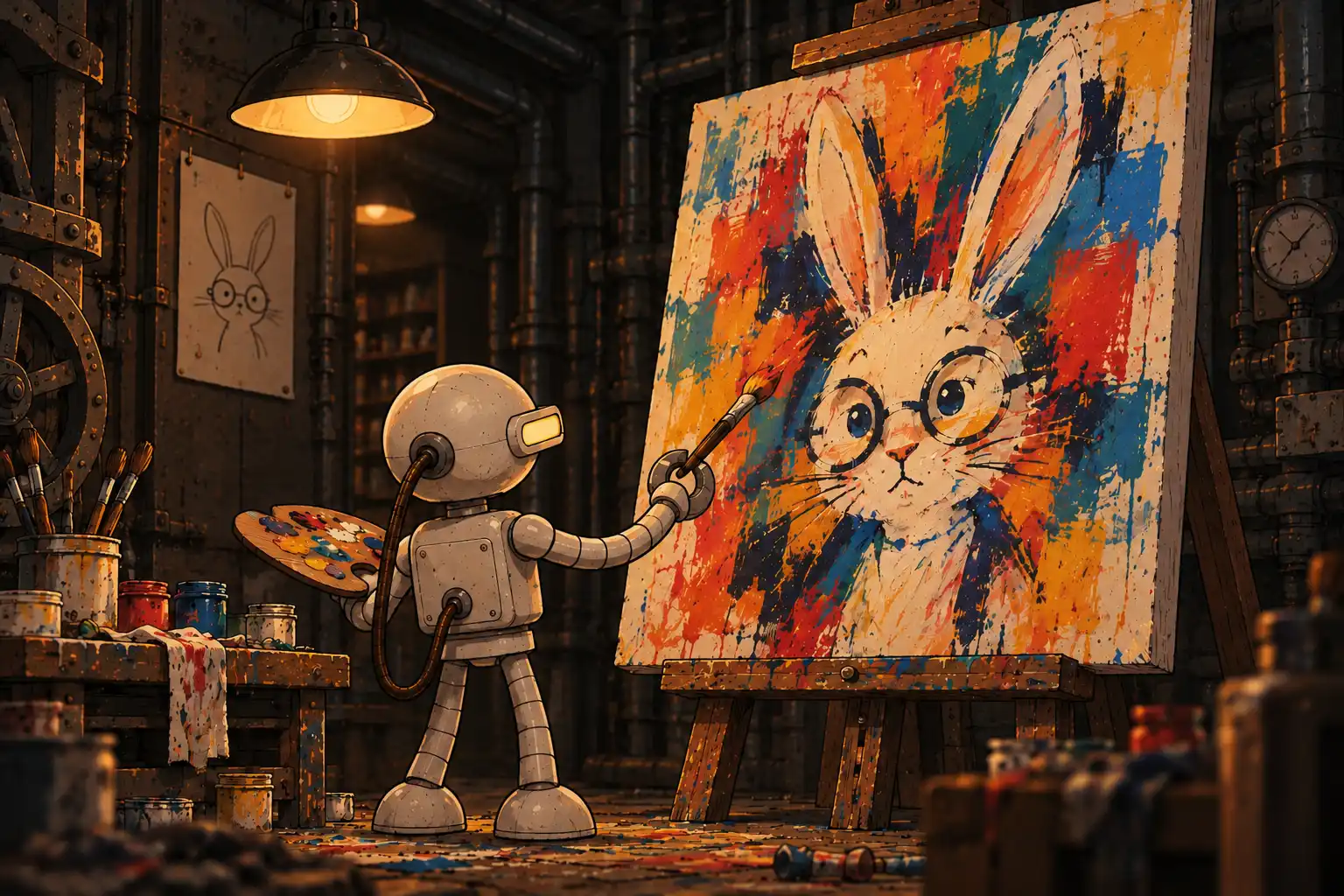
There’s quite a lot of Maschinenraum in between.
I’m right in the middle of it.