The Website Appeared Quickly
Small Symbols started as a side project inside another side project.
I had been playing with the idea of Unwrap Minis: small, carefully made tools that didn’t need to become products of their own. An emoji browser seemed like a good candidate. There are plenty of emoji pickers already, but most of them feel like utilities. Search for something, click it, copy it, leave.
I wanted something closer to an atlas. A place where browsing was useful even when you didn’t know what you were looking for.
With AI, the first version appeared almost immediately. A grid, some collections, a detail view. It already looked surprisingly close to what I had in mind.
That was the cheap part.
What Is a Rocket?
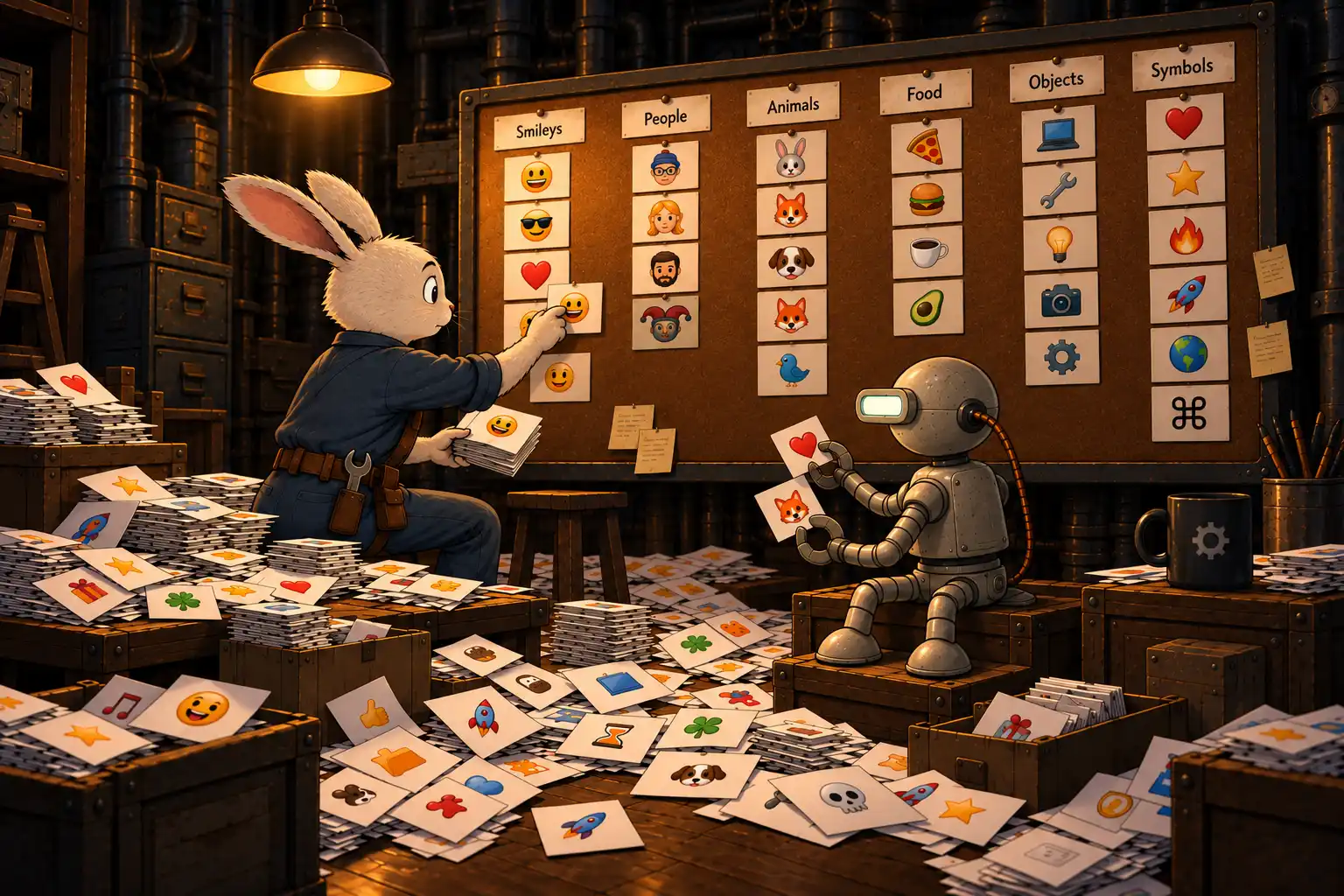
The first real challenge was categorization.
Where does 🚀 belong?
It’s an object, a vehicle, something associated with space and technology. Visually, it could appear in collections about particular shapes or colors. There are several reasonable answers, depending on what someone is looking for.
At first, this sounds like a taxonomy problem: find the correct category and put the rocket there. But there isn’t really one correct category. What matters is where someone would reasonably expect to find it.
A taxonomy is a navigation design, not a court ruling.
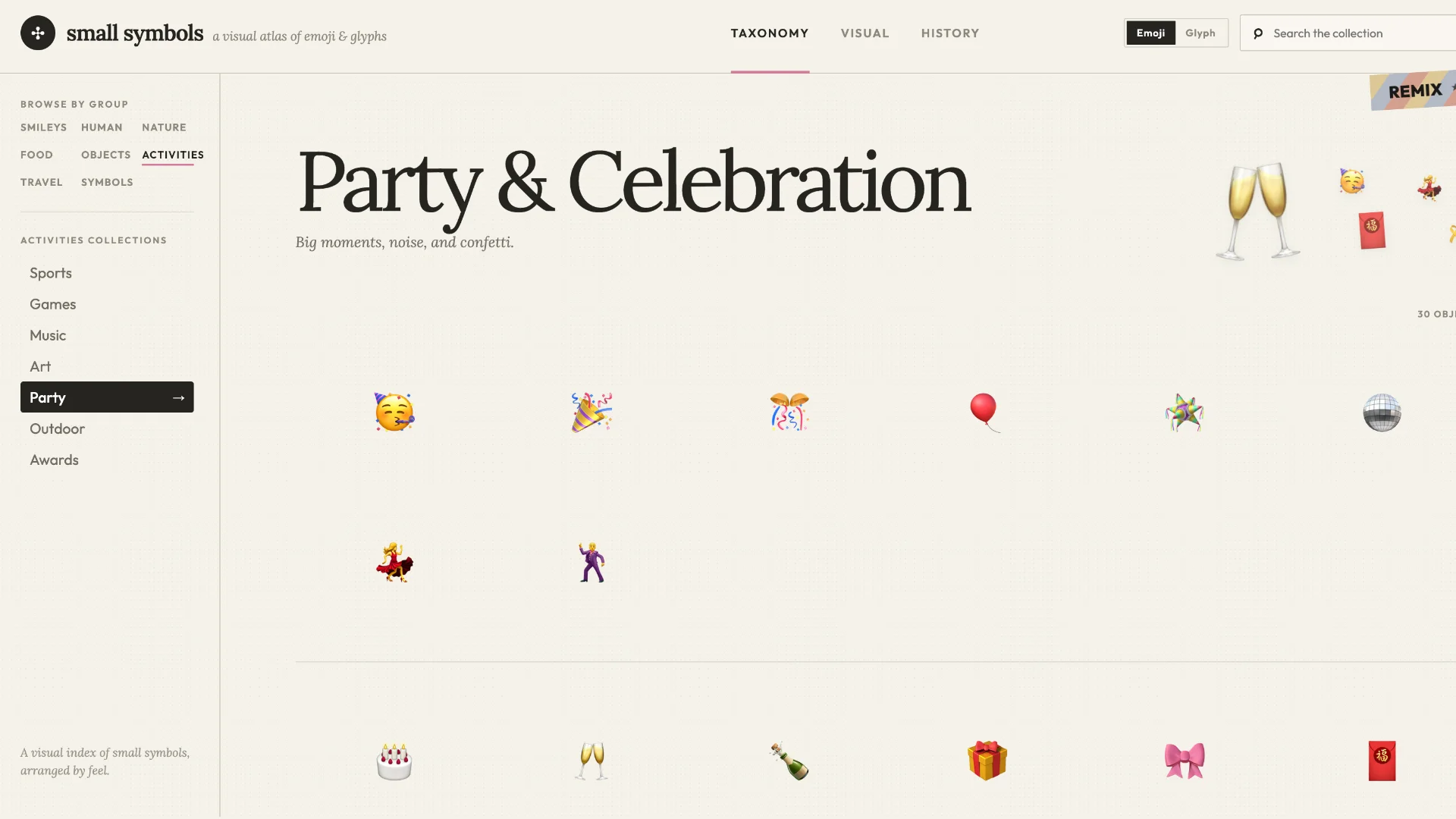
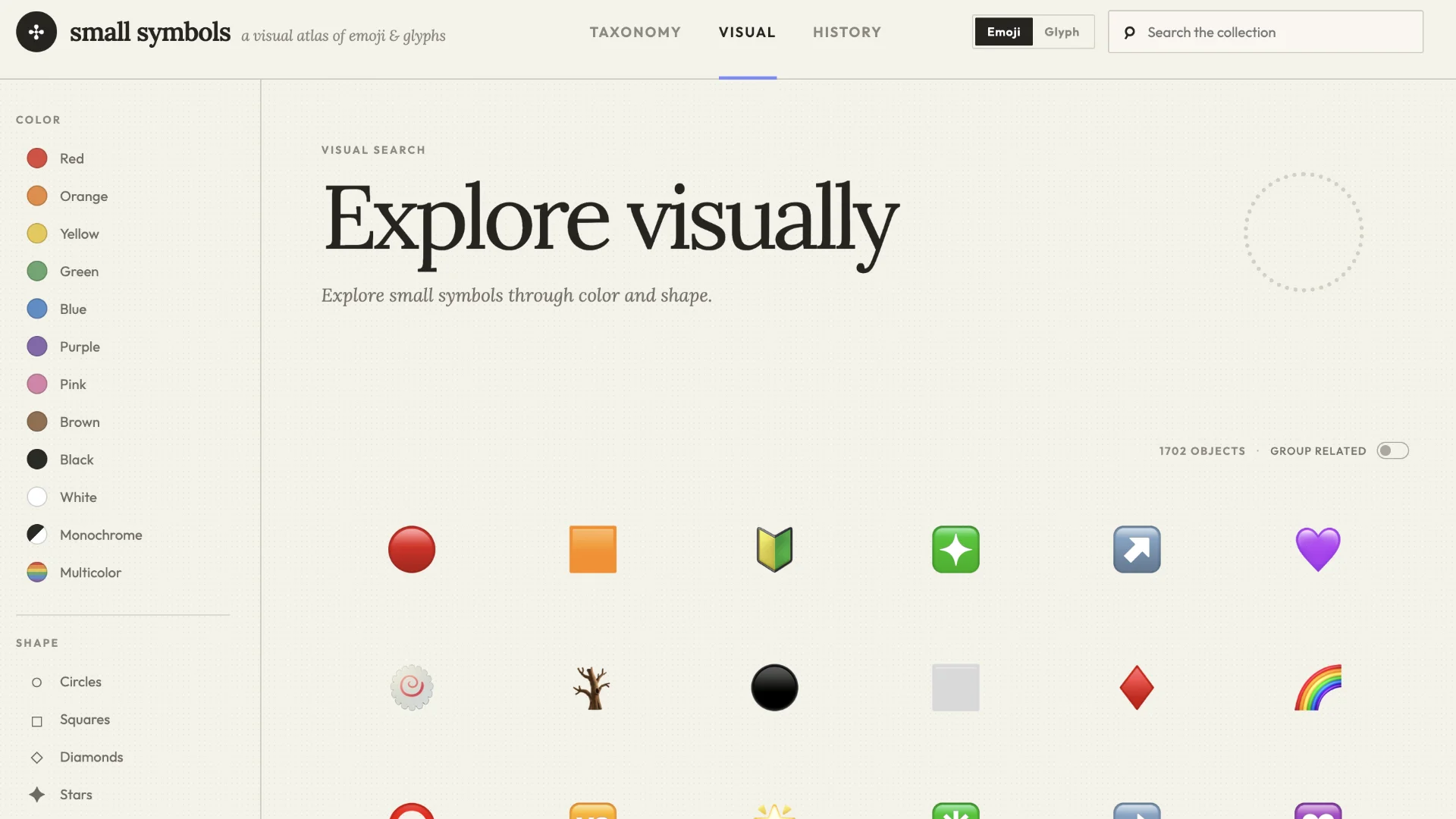
Small Symbols eventually developed several ways to explore the same collection. Taxonomy asks what something represents. Visual asks what it looks like. History asks when it entered the emoji system. These aren’t competing category systems. They’re different questions about the same material.
Within Taxonomy, I still had to make hundreds of small editorial decisions. Faces became Smileys because the original collection had grown too large. Animals split into more specific groups. People doing sports ended up somewhere different from the balls and equipment they use.
None of this is Unicode truth. It’s editorial judgment.
Facts and Opinions
Unicode and CLDR already know an enormous amount about emoji: official names, annotations, valid sequences, versions and when characters were introduced.
I don’t want to maintain any of that myself.
But Unicode cannot tell Small Symbols which collection a rocket should live in, which symbols look good together or how strongly something matches a visual characteristic.
So the data gradually separated into two worlds: facts derived from Unicode and CLDR, and opinions curated specifically for Small Symbols.
The first prototype didn’t make that distinction particularly well. Collections were basically arrays of emoji. Perfectly reasonable when you’re trying to get something working in an afternoon, but increasingly awkward once symbols appear in multiple collections, order carries meaning and variants complicate the picture.
Visual browsing made this especially obvious.
My first idea was to describe every emoji using properties such as roundness, symmetry, detail, visual weight and color. Give everything a score and suddenly I have a multidimensional visual model.
It also felt ridiculous.
Was 🍎 0.82 red? Was 🌕 0.91 round? I would have spent ages assigning precise-looking numbers to subjective impressions.
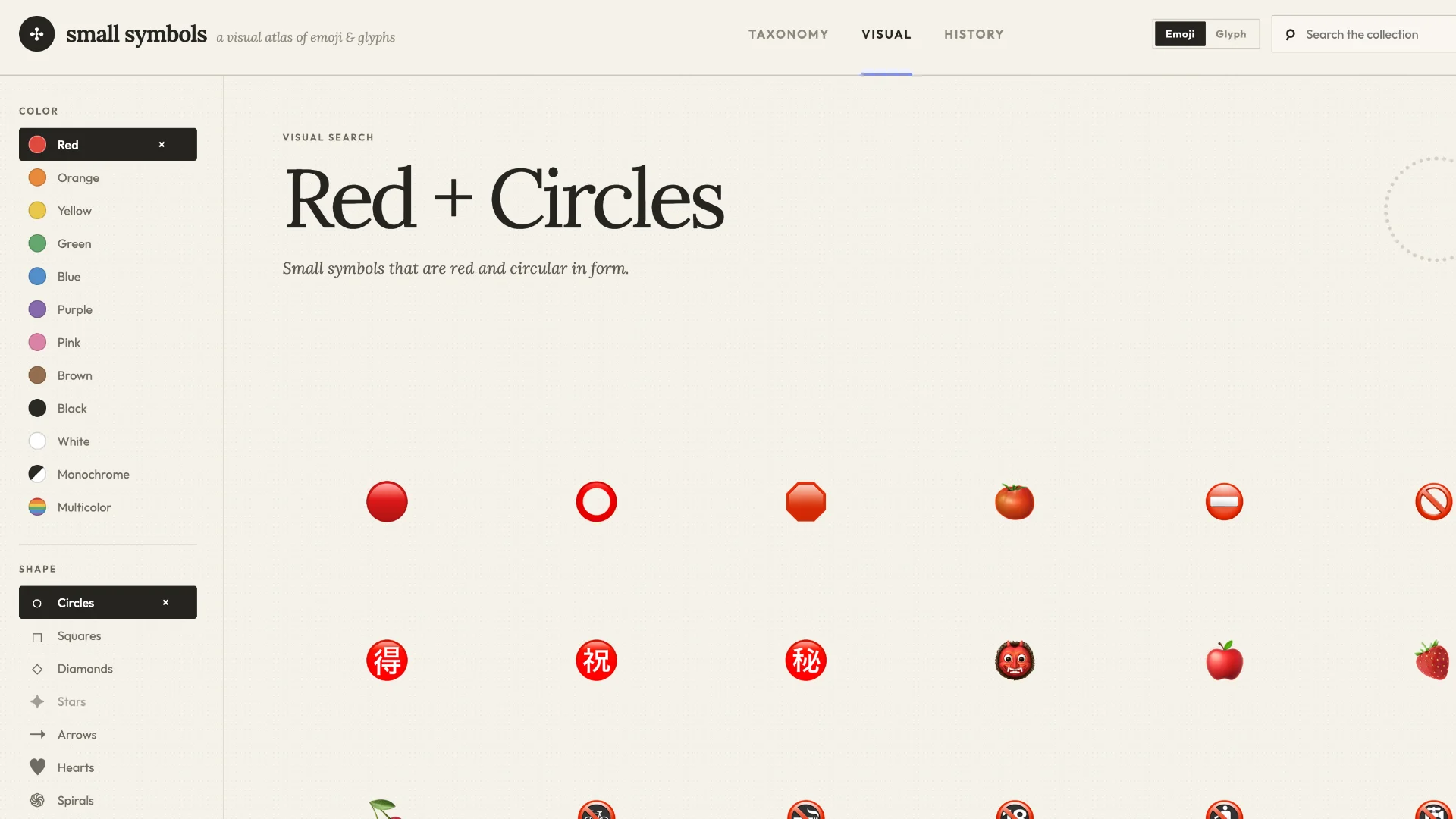
Instead, Visual became a collection of curated characteristics such as Red, Green, Circles, Squares and Stars. Within each collection, symbols receive one of a few understandable strengths: defining, strong, clear, mild or trace.
The application can translate those judgments into numbers when it needs to rank combinations such as Green + Circles. But I don’t have to pretend that my editorial decisions are scientific measurements.
This became a recurring pattern throughout the project. Whenever the data model became more complicated than the decision I was actually making, something was wrong.
The useful model wasn’t necessarily the cleverest one. It was the one that made the intention explicit.
I Accidentally Built a Second Product
Eventually, those editorial decisions lived in increasingly large JSON files: collection membership, ordering, visual strengths, related groups, variants and various exceptions.
Technically, this worked. Practically, it was awful.
Reordering twenty emoji in JSON is possible. Judging the visual rhythm of that order from twenty Unicode characters in a text editor is considerably harder.
So I built an editor.
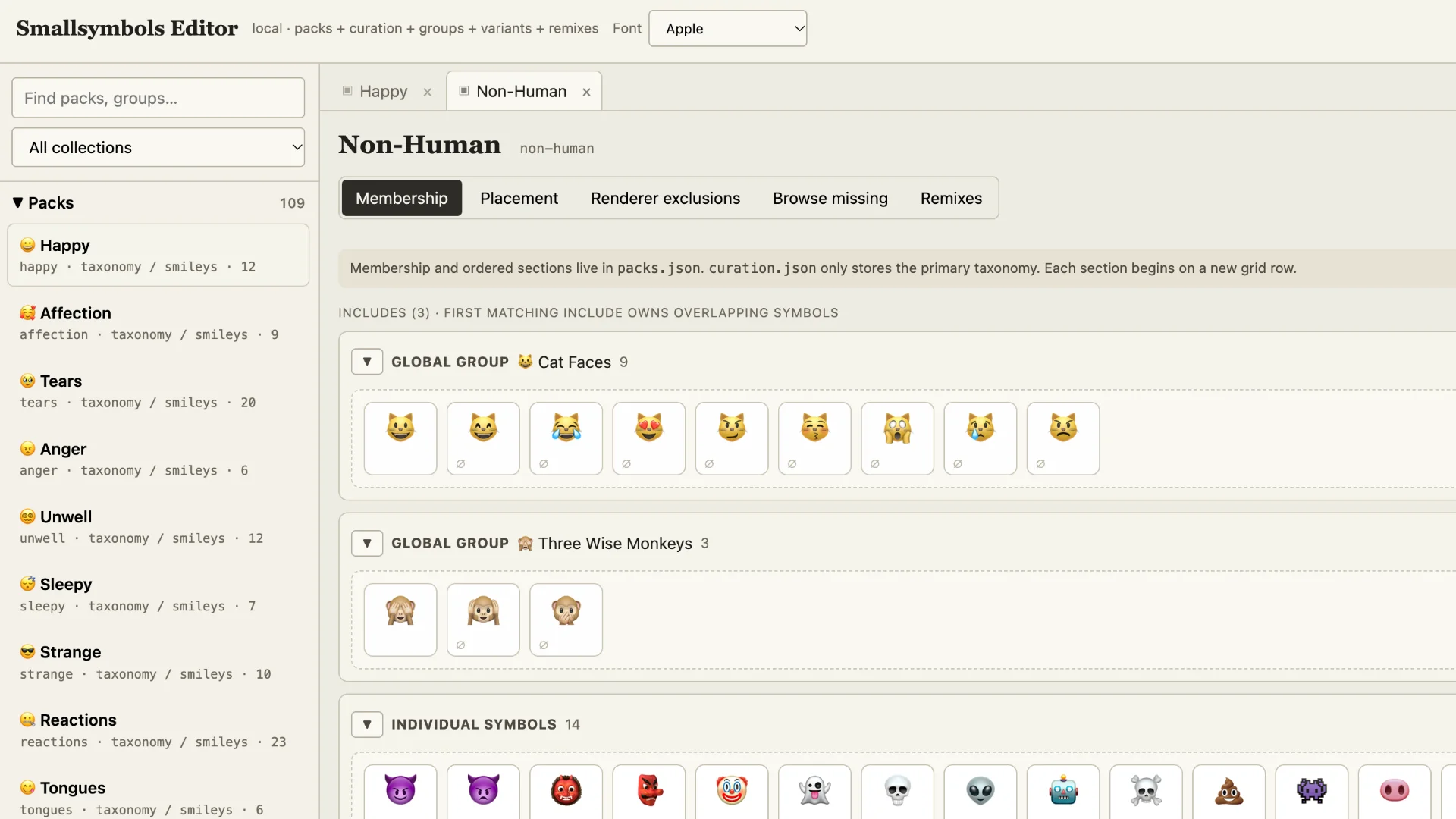
The Curation Studio started as a convenience and gradually became a substantial part of the project. I can drag symbols between sections, edit visual rankings, inspect related groups, manage variants and preview different renderers.
None of this is visible on smallsymbols.com. But without it, maintaining the public website would be miserable.
I had effectively built two pieces of software: one for browsing the collection and another for maintaining the judgment behind it.
If a product depends on sustained curation, the curation interface is part of the product architecture — even when users never see it.
AI Likes Explicit Things Too
I built most of Small Symbols with an AI coding agent, and the experience made this distinction even more important.
AI is remarkably useful for the mechanical work. It can suggest first-pass classifications, find missing entries, migrate data structures and implement UI changes from screenshots.
But it’s also remarkably good at destroying meaning that exists only implicitly.
An array position that secretly represents a weaker visual match is fragile. A giant set of numeric order values is fragile. A special case that only makes sense because I remember why I added it three days ago is fragile.
Named sections, explicit relationships, validation and editor previews made AI-assisted changes much safer.
And then I realized they made the project much nicer for me too.
The best AI-friendly data model turned out to be the best human-friendly data model too.
The agent needs the same thing I do when returning to the code weeks later: enough structure to understand what a change is supposed to preserve.
A Slightly Nicer Emoji Website
The first intensive build phase lasted roughly two weeks.
By then, Small Symbols had more than 1,700 atlas identities, around 90 authored collections, visual ranking, variant families, history, a Unicode/CLDR data pipeline, a Remix system and an entire Curation Studio.
And what did I build?
A slightly nicer emoji website.
That’s the funny part.
From the outside, Small Symbols is deliberately simple. Browse some symbols. Explore collections. Combine visual filters. Copy something you like.
Most of the work went into making that simplicity possible without turning the underlying collection into a pile of special cases.
AI made it absurdly cheap to get the website onto the screen. What took time was figuring out what the website actually meant, and turning those decisions into something I could maintain.
Every few days, an implicit assumption became an explicit concept. A list became a taxonomy. Similarity became editorial rankings. Editing JSON became a Curation Studio.
The visible product didn’t necessarily become much larger.
It just became easier to understand, maintain and extend.