The Future Is Not a Straight Line
Most financial planning starts with the same convenient assumption: that your life will continue more or less as it does today.
You enter your income, expenses, savings, expected returns and perhaps an annual raise. The model draws a line into the future and tells you where you might end up twenty years from now.
The maths is perfectly reasonable. Life is the problem.
Over twenty years, careers change, children arrive, houses are bought, people take time off, inherit money or switch to part-time work. Meanwhile, the stock market may or may not behave anything like the assumptions in your spreadsheet.
So the question I’m interested in isn’t really:
How much will I have in twenty years?
It’s this:
What happens when life changes along the way?

A Baseline Is Only The Beginning
That question led to What If?, a small new tool I’ve been building for Woas I Hab.
It starts with a few basic numbers:
- Current net worth
- Income
- Expenses
- Expected growth
Together, they form a baseline: one possible future in which things carry on roughly as they are today.
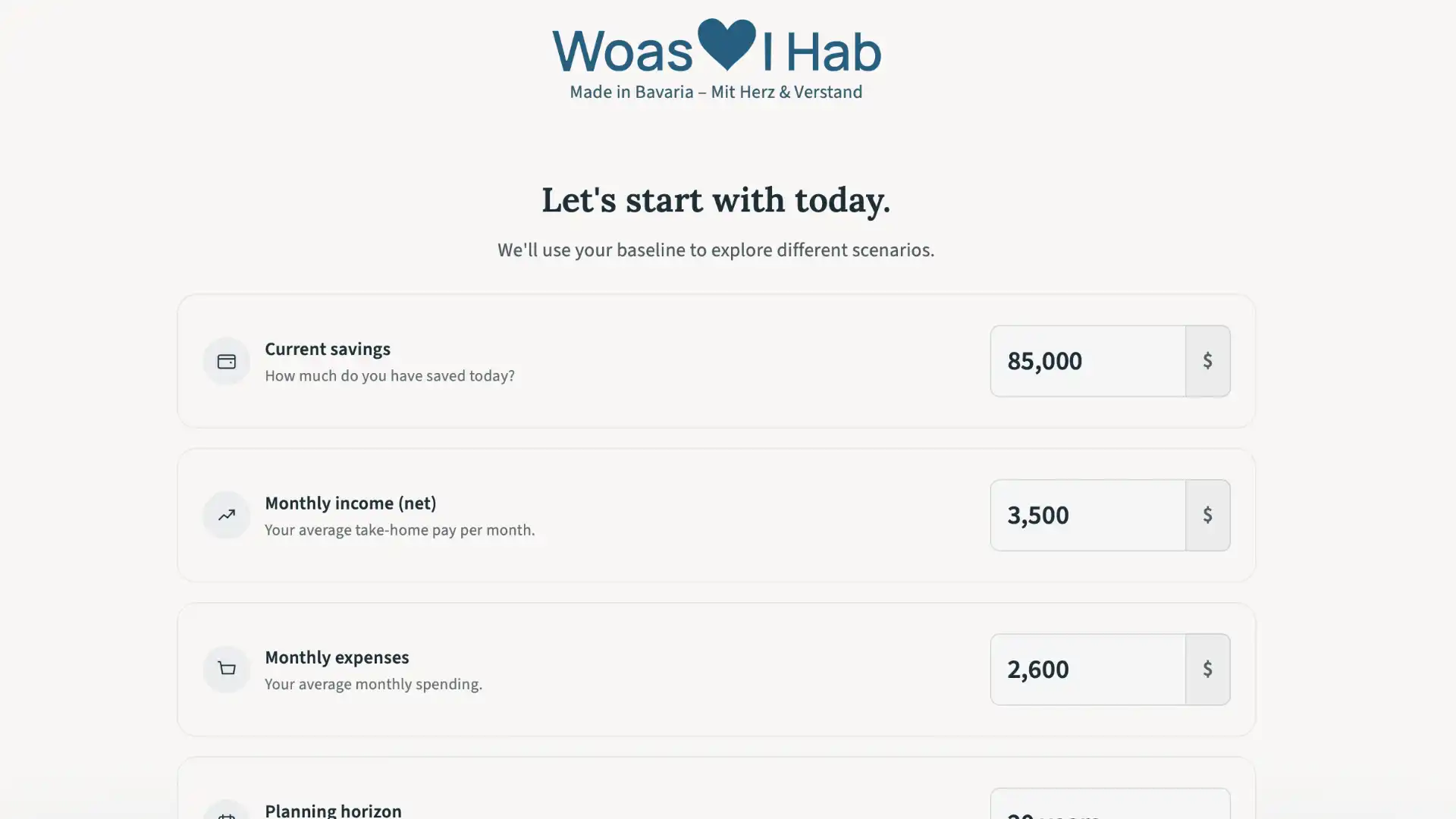
Once that baseline exists, you can start changing it. Add a child five years from now, give yourself a ten-percent raise next year, take a sabbatical or buy a larger house. What If? creates a second path and shows how that change might play out over time.
It isn’t trying to predict the future. It’s trying to give you a feel for the scale of a decision.
That distinction is the central design problem.
There is always a more accurate version of the simulation, with more inputs, more assumptions, more edge cases and more detail. But accuracy is only useful if you can get to an insight in the first place.
What If? is not designed to build the most complete financial model possible. It is designed to help you understand one meaningful change before the model becomes a project of its own.
First The Baseline, Then The Question
The order matters.
I could have started with a long list of life events and asked users to map out the next twenty years. But that would mean planning an entire imaginary life before seeing anything useful.
Instead, What If? begins with something familiar: where you are today and where you might end up if things continue roughly as they are. Only then do you change something and see how the path responds.
This is a deliberate trade-off. The baseline is necessarily incomplete and leaves out many things that could matter, but it gives you a useful starting point quickly, without asking you to describe every detail of your life before the first result appears.
The result isn’t presented as a separate calculation. It appears as a second path next to the first one: a baseline and a scenario, before and after.
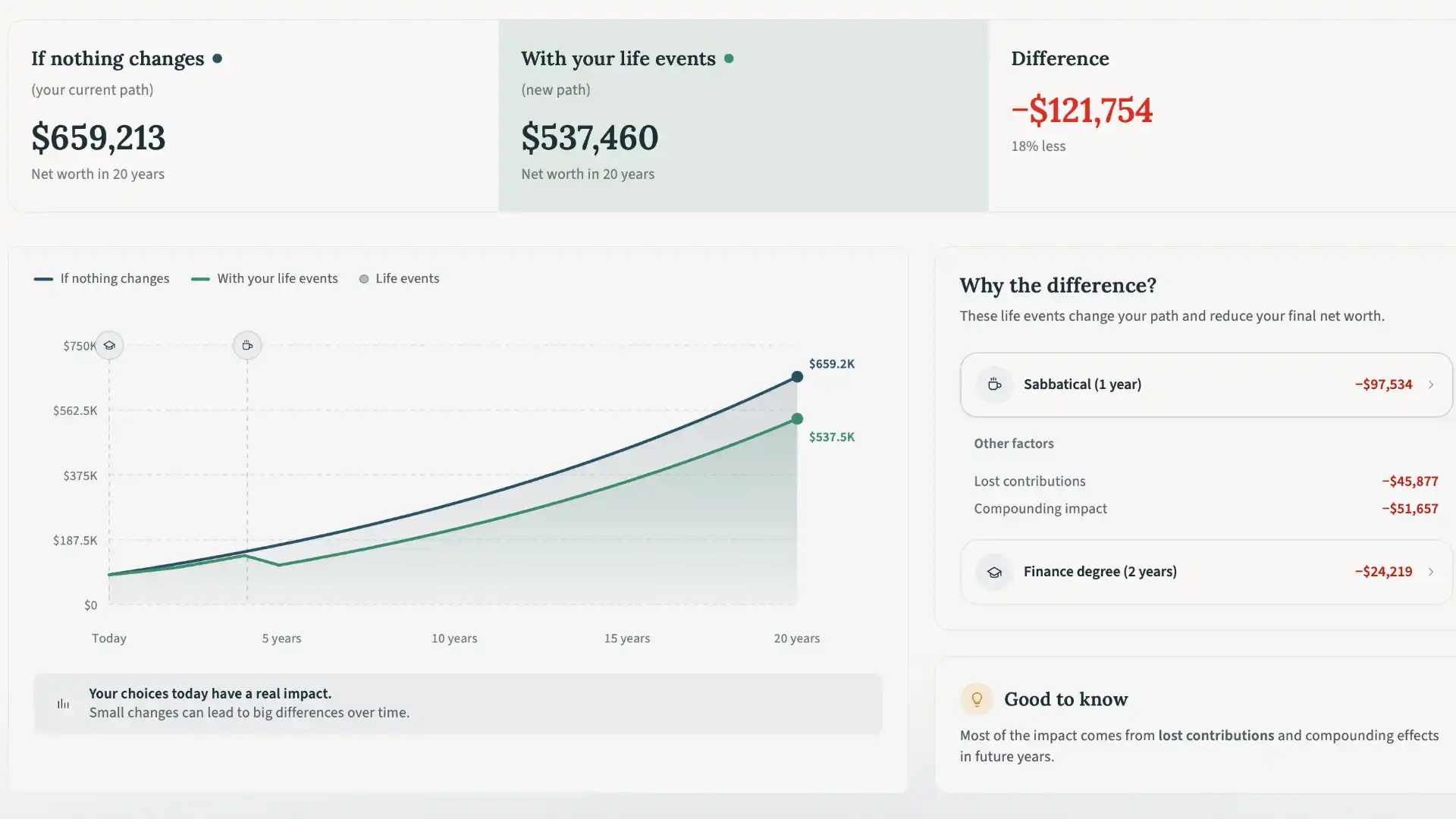
Without that comparison, the result would be just another large number at the end of a chart. The second path shows where the difference begins, how it develops and what caused it. In a way, the first line only becomes useful once there’s another one beside it.
Ten Percent Adds Up
While building the tool, I tried adding a promotion with a ten-percent pay rise. Ten percent more each month sounded good, but not exactly life-changing.
Then I looked at the twenty-year result. Once the additional savings and their returns were included, the difference had grown to well over a hundred thousand euros.
My first thought was:
Fuck. I should probably work on that promotion.
Of course, the number isn’t a forecast. No one knows what markets will do, how a career will develop or what life will get in the way. But the scale of the difference was still useful.
Small changes can compound into surprisingly large ones, while big expenses sometimes matter less over the long run than expected. Some decisions change the trajectory immediately; others take years to show up. That’s difficult to develop an intuition for from a monthly number, but it becomes much easier once you can see the paths diverge.
This is the kind of insight I’m interested in: not a perfectly accurate answer twenty minutes from now, after filling in every possible variable, but a useful answer in the next minute or two that is good enough to change how you think about the decision.
The Number Is Not The Answer
Having a child can be extraordinarily expensive and still be the best decision of your life. A sabbatical can leave you with less money and be worth every euro. A promotion may transform your finances while making your working life worse.
What If? can’t weigh any of that, nor should it. Its job isn’t to recommend one life over another, but simply to show what a decision could mean financially.
That distinction became increasingly important while I was building it. Financial software has a habit of presenting uncertain outcomes with suspicious precision. Once a chart ends at €742,381, the number begins to look like a fact.
It isn’t. It’s the result of a set of assumptions.
A more detailed model might produce a more precise number, but it might also make the result harder to understand, harder to question and harder to reach. For this kind of tool, precision is not automatically the same as usefulness.
A scenario can help you understand a decision without pretending to make that decision for you.
The Future Is Really A Set Of Scenarios
The more I worked on What If?, the less the future looked like a single line. Life events are only one part of it.
What happens if the market crashes shortly before retirement? What if returns stay unusually low for a decade, or turn out to be exceptionally strong? What if I stop working at 55, or switch to part-time work at 50?
Things become especially interesting when several changes overlap, because real decisions rarely affect just one number.
Buying a €500,000 house, for example, is not simply a €500,000 expense. Investments may have to be sold, taxes may become due on the gains and a mortgage creates interest payments. At the same time, the house becomes an asset that may change in value, while years later something expensive inevitably starts leaking.
One event can affect income, expenses, investments and net worth at the same time.
A fully accurate model would need to represent all of those relationships. But that does not mean all of them need to be represented before the tool can be useful.
The current version of What If? can’t model all of that. That’s fine. It can still help you ask a better first question.
Every Assumption Becomes A Question
It’s easy to imagine a more accurate version: taxes, inflation by spending category, several investment portfolios, changing interest rates, detailed mortgages and probability ranges for future returns.
Each addition would make the simulation more complete. But every new assumption eventually turns into another question for the user, another field, another explanation and another decision that has to be made before the first useful result appears.
Follow that path far enough and you end up asking someone 47 questions before drawing a single line.
At that point, the model may be more accurate, but the product has become less useful. Not because the calculations are wrong, but because fewer people will get far enough to see what they mean.
That is the trade-off I kept coming back to while building What If?: not how to include every relevant detail, but what the smallest model is that can still produce a useful insight.
For now, the flow is deliberately simple: start with today, see the baseline, change one thing and see what it changes.
The model can grow more sophisticated later. The first few minutes shouldn’t.
Version 0.1
What If? is deliberately small. It supports a handful of basic life events and models how income, expenses, investments and net worth might develop over time.
There’s no Monte Carlo simulation, no tax engine, no complex portfolio management and no 47-field questionnaire before anything happens.
I already have enough ideas to keep working on it for months. But building all of them first would have meant not releasing What If? for months either.
So version 0.1 is out.
It isn’t finished, and it won’t predict your future, but it lets you explore a few possible versions of it without building a complete financial model first.
Perhaps that’s a more honest way to approach long-term financial planning anyway: not by pretending there is one line waiting to be calculated, and not by confusing more detail with more certainty, but by starting with a simple model, looking at a few different paths and understanding what might happen along the way.
The goal is not to simulate everything.
It is to get to something useful before the simulation gets in the way.